Is German Hard to Learn?
German is moderately hard for an English speaker, and — more usefully — it is hard in a specific and unusual order. It hands you the beginning almost free and charges for the middle, which is the opposite of the languages it is most often compared with.
That is why the honest answer to this question is never a number. A difficulty score would tell you nothing about the thing that actually decides whether you keep going, which is where the wall is and what it is made of.
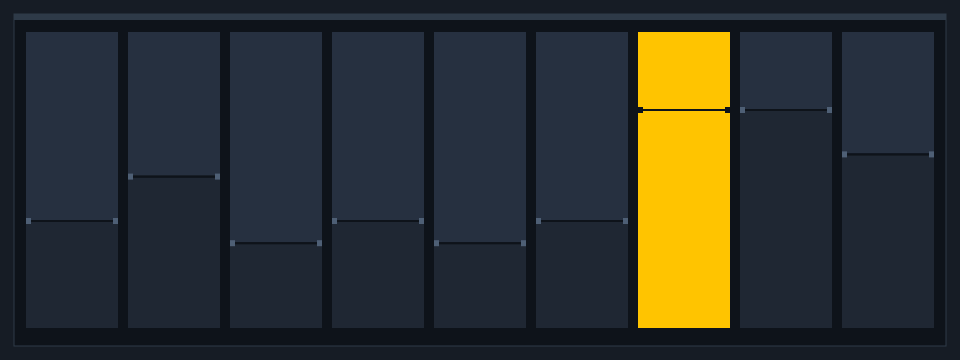
Classroom hours the FSI publishes for each of its four bands
What the only published ranking says
There is exactly one ranking of language difficulty that is worth quoting, and it puts German one step above French and Spanish and a very long way below Japanese. It comes from the United States Foreign Service Institute, which trains American diplomats and publishes the timelines its own students take.
On its published table, read on 24 September 2026, German sits in the second of four bands at approximately 36 weeks, or 828 class hours. The first band — the languages it calls close to English, including French, Spanish, Italian, Dutch and Swedish — runs from 24 to 30 weeks. The third band is about 44 weeks. The fourth, which it labels super-hard and which holds Japanese, Korean, Mandarin and Arabic, is 88 weeks or 2,200 class hours.
So German is a step up from Spanish and roughly a third of the way to Japanese. That is the whole of what the ranking says, and it is worth being clear that the number is measuring diplomats in a classroom rather than you.
The easy part, which is genuinely easy
Two of the four things that usually make a language hard, German mostly waives, and it waives them right at the start where morale is most fragile.
The spelling system is close to regular. Learn what each letter and letter-combination sounds like — a list, not a lifetime — and you can pronounce a word you have never seen, and spell a word you have only heard. English speakers underrate how rare this is, because English itself is so spectacularly bad at it. In German, the written word and the spoken word are the same object.
The everyday vocabulary is half-familiar. Hand, Haus, Arm, Finger, Wasser, Winter, Garten, Butter, Brot, Milch. English and German are cousins, and the split left the kitchen-and-weather layer of both languages recognisably related. For a while you are identifying words rather than memorising them.
Add to that: German has no tones, no writing system to learn, and a small enough sound inventory that an English speaker's mouth can get most of it approximately right within weeks. The famously difficult sounds — the two ch sounds, the r, the front rounded vowels written ü and ö — are a short list, and none of them changes a word into a different word as often as, say, a French nasal vowel does.
The expensive part, which arrives later
German charges in one place, and it charges a lot: the machinery you must operate before you are allowed to finish a sentence.
The first piece is the article system. Every noun is der, die or das, that choice is mostly not predictable from meaning, and it is not a label — it feeds a table that also changes according to the noun's job in the sentence. A gendered noun in Spanish mostly affects the word next to it. A German noun's gender plus its grammatical case together decide the shape of the article, the adjective ending, and sometimes the noun itself. You need this before you speak, not after.
The second is word order. The working verb goes second in a main clause and last in a subordinate one, and a whole category of verbs splits in two and posts its prefix to the end. That means you cannot improvise a German sentence forward the way you can improvise a Spanish one, repairing as you go, because how it ends is determined by a decision you took at the start. This is the thing that makes fluent speakers of other languages feel oddly slow in German.
The third arrives last and surprises people most. English built its formal, abstract and technical vocabulary mostly by borrowing from Latin and French, which is why an educated English speaker can often guess an unfamiliar word in a Romance language. German mostly did not borrow that layer — it assembled it from German parts. Fernsehen for television, Krankenhaus for hospital, Wahrscheinlichkeit for probability. The free ride on vocabulary therefore ends precisely at the point where you start wanting to read something interesting.
Why this order matters more than the difficulty
Put those two lists together and you get the experience almost every German learner reports and almost no course warns about: a delightful first month, and a fifth month that feels like hitting a wall at speed.
Nothing has gone wrong when that happens. The first month was spent on the parts German gives away, and they are real progress — but they are not a preparation for the parts it charges for. A learner of Spanish meets grammar gradually and vocabulary that keeps helping. A learner of German meets almost no friction and then most of it at once.
The practical consequence is a warning about what to buy. A product that is excellent for eight weeks is easy to build in German, and there are many of them. Judge anything you are considering by what it does for the article table, for word order, and for the moment the cognates run out — and the board of routes is arranged around exactly that question.
What is not hard, despite the reputation
Long words are not a difficulty. German writes compounds as one word where English writes them as several, so Geschwindigkeitsbegrenzung looks alarming and is just speed-limit with the spaces removed. Once you can see the seams, long words are easier than English's borrowed vocabulary, because the parts tell you the meaning.
Pronunciation is not the difficulty either, whatever the language's reputation for harshness suggests. It is regular, it is learnable from a list, and the specific sounds worth working on are a short and finite set.
And the cases are not conceptually hard. Four of them, with a logic that makes sense within a week. The cost is not understanding them; it is making them automatic, which is a matter of volume rather than intelligence — and it is why the drills, not the explanations, are the part worth paying for.
So: is it hard?
It is harder than Spanish, easier than Russian, and a different shape from both. If you have three months and want to be able to say things on a holiday, German will feel easy and you will be right. If you want to read a newspaper or argue in a meeting, the second half costs more than the first half did, and most of that cost is drilling one grammar system until you stop having to think about it.
Neither half is a reason not to start. But knowing which half you are in stops you from concluding, in month five, that you are bad at languages.
Questions people ask at the board
Is German harder than English?
Is German the hardest language to learn?
What is the hardest part of German?
Why is German so hard to learn for English speakers?
Can I learn German if I am bad at languages?
The whole board is on one page: every route into German with its price as read. If you would rather spend nothing first, start with the German you can learn for free.