How Long Does It Take to Learn German?
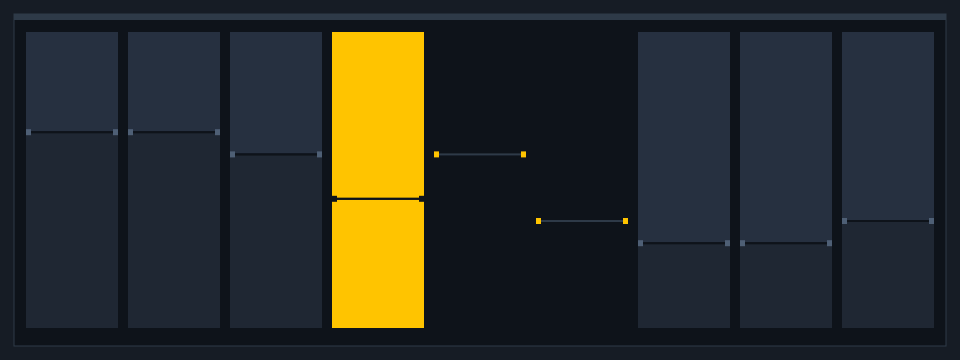
There is exactly one credible published figure for how long German takes, it belongs to the US Foreign Service Institute, and it says approximately 36 weeks or 828 class hours. It is a real number and it is almost certainly not about you.
This page explains what it measures, why that matters, and why you will not find a conversion into evenings-per-week anywhere on this site — including in the sentence you were hoping would be here.
Classroom hours the FSI publishes for each of its four bands
What the number actually measures
The Foreign Service Institute trains diplomats for the United States government, and it publishes the timelines its own students take. Read from its page on 24 September 2026, its four bands are these: the first, "languages close to English", at 24 to 30 weeks or 552 to 690 class hours; the second at approximately 36 weeks or 828 class hours; the third, which it calls hard languages, at approximately 44 weeks or 1,012 hours; and the fourth, "super-hard languages", at 88 weeks or 2,200 hours.
German is in the second band, alongside Haitian Creole, Indonesian, Malay and Swahili.
Three details from the same page do most of the work, and they are the ones that get dropped when the figure is quoted elsewhere.
First, the student. These are full-time government language students, selected and paid to study, taught in small groups by professional instructors. The page states the load: "A typical week is 23 hours per week in class and 17 hours of self-study." That is a forty-hour week, as a job.
Second, the destination. The page says the timelines indicate the time "usually expected for a student to reach an integrated score of 3 (Speaking + Listening) on the Interagency Language Roundtable (ILR) scale". That is a defined professional working proficiency on a government scale — not "fluent", not a CEFR level, and not "can chat on holiday".
Third, the caveat, which the FSI writes itself: the actual time "can vary based on several factors, including the language learner's natural ability, prior language-learning experience, and time spent in the classroom".
An oddity in the table worth knowing about
Do the arithmetic on the FSI's own numbers and something small shows up. Three of the four bands are internally consistent with the 23-hour teaching week the page describes: 24 weeks by 23 hours is 552, 30 by 23 is 690, 36 by 23 is 828, and 44 by 23 is 1,012. Every one of those is exact.
The fourth band is not. 88 weeks at 23 hours would be 2,024, and the page says 2,200, which works out at 25 hours a week instead.
This is not an error worth making a fuss about, and no claim is made here about why it is there. It is worth one paragraph for a single reason: it shows that these are hand-maintained planning figures kept by an institution for its own use, not the output of a formula. Treat them as an experienced organisation's estimate of its own programme, which is what they are, and not as a constant of nature.
Why this page will not convert it for you
The tempting move is obvious: take 828 hours, divide by an hour a day, announce two and a bit years. Every site that does this is inventing a number, and the invention hides in the division.
Those 828 are classroom hours with an instructor, and they sit on top of 17 hours a week of the student's own study — so the total programme is far larger than the quoted figure. An hour alone with an app is not equivalent to an hour in a small class with a professional correcting you. A full-time student is immersed in a way an evening learner is not, and forgetting between sessions works very differently at forty hours a week than at five. And the destination is a specific score on a scale most readers have never been measured against.
Four unknown conversion factors multiplied together do not produce an estimate. They produce a number with a citation attached to it, which is worse than no number at all, because it looks checkable.
So: no fluency timeline appears anywhere on this site. Not for German, not for a level, not for a "conversational" standard that nobody defines.
What sellers say, and how to read it
You will meet timelines, and they are marketing rather than measurement. Pimsleur's German course page carried the line "Speak at an Intermediate Level in 30 Days" on 24 September 2026 — its own claim about its own product, unaudited, with "intermediate" undefined in that sentence. Rocket German's packages escalate from "a good conversational level" to "a very good conversational level" to "an advanced conversational level" as the price rises, and defines none of the three.
Babbel's own guide to learning German quotes the FSI figure, which is to its credit — and calls it "an exact number", attributing it to "the United States Foreign Language Training service". The figure is right. The name of the organisation is not, and "exact" is the opposite of what the FSI's own page says about it, twice. That is a fair illustration of what happens to this number on its way around the internet, and it is why the source is linked and dated here rather than paraphrased.
Lingoda's Sprint pages describe a two-month course as moving you "up to 1 CEFR level", or up to 1.5 on the more intensive version. As vendor claims go that is unusually specific and unusually modest, and it is still the seller's claim.
What actually determines your answer
Since nobody can give you a duration, here is what genuinely moves it, in rough order of size.
Consistency beats intensity, and it is not close. German's main cost is making one grammar system automatic, and automaticity is built by frequent contact, not by long sessions. A person doing twenty minutes daily will pass a person doing three hours on Sunday.
Speaking early costs you dignity and saves you months. The article-and-case machinery has to be operated in real time, and the only way to practise operating something in real time is to operate it badly first.
Whether anybody corrects you is the biggest single difference between two learners with the same hours. Without correction you become fluent at your own mistakes. This is the entire argument for an hour with a teacher over another subscription, and it is why the board sets that route against the others.
And what you mean by "learn German" changes the answer by a factor of several. Ordering food, following a film, sitting an exam and working in German are four different destinations, and the level system exists precisely to stop people comparing them.
The honest summary
One organisation publishes a German figure: approximately 36 weeks, 828 class hours, for a full-time student reaching a defined professional score. German sits one band above French and Spanish and far below the 2,200 hours of the hardest band.
Everything beyond that is either your own record of your own hours, or somebody's guess wearing a citation. This site would rather leave the gap visible.
Questions people ask at the board
How long does it take to become fluent in German?
Can I learn German in 3 months?
How long to reach B1 in German?
Is 30 minutes a day enough to learn German?
Does German get easier or harder over time?
The whole board is on one page: every route into German with its price as read. If you would rather spend nothing first, start with the German you can learn for free.